China’s navy has introduced a guided missile frigate built to conduct operations near the coast and across open seas, according to Chinese state media.
Developed over roughly two decades, the vessel is less a technological marvel than another calculated addition to Beijing’s rapidly expanding fleet.
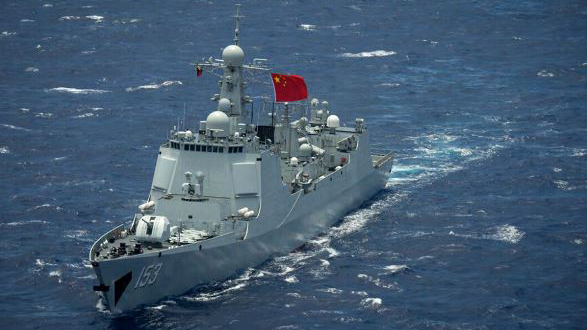
The Type 054A frigate, also known as the Jiangkai II, is not considered revolutionary by military analysts.
Even so, its versatility, potential production volume and ability to support larger warships are giving Taiwan, Japan and the United States plenty to watch.
Unlike earlier Chinese frigates designed mainly for coastal missions, the Type 054A can operate in blue waters far from China’s shores.
That expanded reach gives the People’s Liberation Army Navy another platform for sustained missions beyond the Chinese mainland and into strategically contested waterways.
David Silbey, a military historian and associate teaching professor at the Cornell Brooks School of Public Policy, compared the frigate’s mission profile with that of the United States Navy’s Constellation class.
Its ability to leave coastal waters helps Beijing fill a long standing gap between smaller patrol vessels and major surface combatants.
The Type 054A can also conduct submarine hunting operations using embarked helicopters.
Those aircraft extend the ship’s detection reach, allowing crews to search a significantly larger area for hostile submarines than shipboard sensors could cover alone.

Silbey noted that China could produce the frigates quickly and in substantial numbers. That matters because naval power is not measured only by one ship’s missile cells or sensors, but also by how many hulls a nation can deploy, maintain and replace.
Chinese state broadcaster CCTV News reported that a Type 054A conducted a training mission on Aug. 22.
Operating with a People’s Liberation Army Eastern Theater Command flotilla, it participated in combat training, command coordination testing and emergency response drills.
For Taiwan, the concern is obvious because Beijing has intensified military activity around the self governed island since 2022.
“Taiwan is concerned about its increased anti-submarine, escort and fleet air defense capabilities around the Taiwan Strait,” said Huang Chung-ting, associate research fellow with the Institute for National Defense and Security Research in Taipei.
Japan is also watching closely as Chinese vessels operate across the East China Sea and near routes leading into the Pacific.
“Japan will pay attention to its activities in the East China Sea, the Miyako Strait and around the first-island chain,” Huang said.
That island chain includes Japan and other land masses positioned between China and the open Pacific.
Beijing already disputes Japanese control of a group of uninhabited islets, while Communist Party officials remain irritated by Tokyo’s increasingly firm position on Taiwan.
Washington’s concern reaches beyond any single deployment because China is building the infrastructure for prolonged operations far from home.
Huang said American officials would examine whether Beijing is creating a “large enough modern escort fleet” capable of sustaining long term deployments in open waters.
The frigate may prove especially useful when paired with China’s larger destroyers, amphibious ships and aircraft carriers. Enrico Cau, an associate researcher at the Taiwan Strategy Research Association, described it as a “multiplier for bigger units in a vast array of tasks”.
Chinese media have presented the Type 054A as the second Ningde branded ship type following the Type 056 guided missile corvette, which entered service in 2016.
Analysts, however, see little unique technology aboard the frigate and no reason to confuse mass production with genuine innovation.
Its missile capacity is considered “limited,” and Silbey called it “not a particularly powerful ship,” when assessed on its own.
Yet focusing only on individual firepower risks missing Beijing’s broader strategy of combining numerous specialized vessels into a larger and more persistent maritime force.

The ship’s real value is its ability to escort larger units, screen against submarines, contribute to fleet air protection and operate where smaller Chinese vessels cannot.
Beijing does not need every warship to be a floating superweapon if those ships can collectively stretch American and allied surveillance resources.
“I think the multirole designation allows it to cover an important gap between smaller ships designed for a limited set of littoral, coastal and short-range missions and bigger ships designed for different tasks in long range missions,” Cau said.
China continues claiming Taiwan as its territory while Washington supplies Taipei with weapons intended to deter or defeat an invasion.
The Type 054A may be middling by modern warship standards, but a large fleet of middling ships can still create a first rate strategic headache.