Just days after the Air Force celebrated its new wave of technical sergeant promotions, the service is now scrambling to undo a humiliating mistake that has left hundreds of airmen in limbo.
In a stunning reversal announced Tuesday, 135 staff sergeants from the security forces branch—believed they had earned a hard-fought promotion—were told their advancement has been canceled due to a testing error.
The misstep comes from the Air Force’s own testing process, where a written exam used to rank and promote airmen was scored incorrectly.
Officials admitted that an answer key blunder misgraded 27 questions on the Specialty Knowledge Test, resulting in inflated scores for 135 staff sergeants who were never supposed to make the cut.
Last week, families, commanders, and units celebrated the supposed accomplishment. Parties were thrown, photos were taken, and commanders pinned on new chevrons as proud families watched. Now, those celebrations have become bitter reminders of what the Air Force is describing as a “highly unprecedented anomaly.”
According to the Air Force Personnel Center, the error wasn’t the result of artificial intelligence—something that would likely have brought even more public backlash—but simple human error.
“No artificial intelligence products were used in the erroneous promotion cycle process; it was the result of human error,” the service said in a statement.
That “human error,” though, has real-world consequences. Many of those airmen planned their careers, finances, and even family relocations around their expected promotion. Some were likely preparing to re-enlist or extend their careers based on the belief they would now be technical sergeants, a rank that often secures full retirement benefits after twenty years of service.
Air Force Chief Master Sgt. David R. Wolfe admitted, “This is going to be hard for everyone impacted.” That might be an understatement. The 135 airmen demoted back to their prior rank will now have to face their peers—some of whom, ironically, benefited from the same mistake and are now on the corrected promotion list.
Security forces, the Air Force’s largest career field with 43,000 enlisted “Defenders,” is central to the day-to-day safety and law enforcement duties on bases around the world.
These airmen are typically the first line of defense at the gates, on patrols, and in interactions with civilian agencies. For many of these troops, advancement opportunities are already scarce, so a malfunction in the system cuts particularly deep.
Tuesday’s announcement said that a total of 2,285 staff sergeants in security forces took the written exam earlier this year. When scores were initially calculated, the top 586 were told they’d made the grade for promotion. Then came the re-score, which revealed that 135 of those airmen didn’t actually qualify.
Their promotions vanished instantly, while another 135—previously overlooked—were moved up into the rightful promotion slots.
Lt. Gen. Jefferson O’Donnell, the Air Force’s deputy chief of staff for manpower, personnel, and services, tried to calm the waters by emphasizing fairness: “We promote Airmen based on merit, which is established in federal law and policy. We have a core obligation to ensure the airmen who earned it are selected.”
Fairness is one thing. Competence is another. For a branch that prides itself on precision and technical excellence, this kind of bureaucratic flop raises serious questions about oversight and accountability inside the War Department’s testing systems.
The Air Force says it is now kicking off a “thorough review” of the grading and ranking process, adding “quality-assurance safeguards” to prevent what they called a “specific point of failure.”
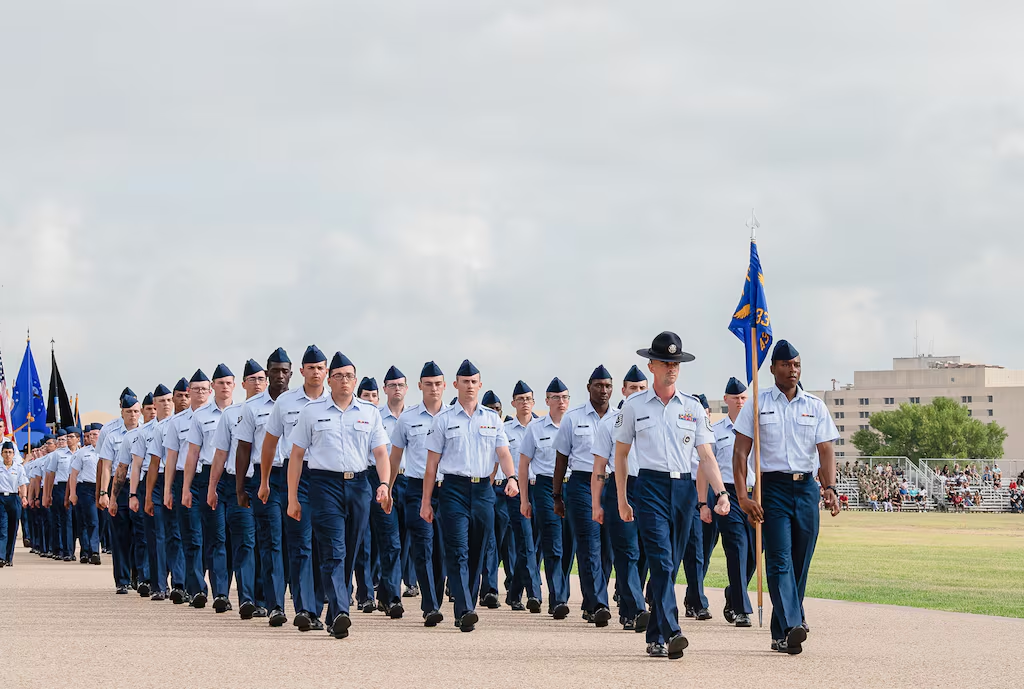
Still, that’s cold comfort for the 135 airmen whose careers were temporarily elevated—and then abruptly brought back to earth. Some might wonder if public transparency and regular audits could prevent a repeat of this kind of mishandling. Instead, what they’ve witnessed looks like another case of bureaucratic chaos in uniform, where the lower ranks bear the brunt of an upper-level mistake.
The Air Force insists this was an isolated incident. But considering it affected the single largest enlisted career field in the service, the word “isolated” doesn’t quite fit.
Whether by oversight, laziness, or a rushed process to meet promotional deadlines before the July 4th weekend, it reveals cracks in a system that demands accountability from its airmen but too often forgets to hold its administrators to that same standard.
While the Air Force reshuffles the promotion lists and tries to put a glossy spin on the fiasco, airmen are left with a hard lesson: inside the bureaucratic juggernaut of today’s military, even when you do everything right, the system can still let you down.