An Air Force major is now confined to base and under investigation after an ill-advised political stunt on Capitol Hill that turned into a spectacle of disgrace for the uniform he wore.
Maj. Jason Watson, a 17-year veteran of the service, took it upon himself to stand on the steps of the House of Representatives holding a sign calling for the impeachment and removal of President Donald Trump and Vice President JD Vance.
For three minutes in blistering July heat, Watson stood silently in full uniform, attempting to send a political message from America’s military ranks to the President.
Capitol Police swiftly arrested him for unauthorized demonstration, applying standard law to what was nothing short of a politically motivated publicity act.
Watson’s choice to use his service uniform as a prop in a partisan protest violated one of the most fundamental pillars of the American military ethos: strict neutrality in political affairs. His actions immediately triggered the scrutiny of the Air Force’s Office of Special Investigations, which coordinated his transfer into Air Force custody directly from a D.C. courthouse.
Jessica Denson, an anti-Trump activist and founder of the so-called Removal Coalition, proudly claimed credit for helping Watson plan the protest. Denson framed Watson’s arrest as an act of “courage” in calling out what she described as a “tyrannical and illegal administration.”
Her comments, dripping with political bias, underscored the exact reason why service members are barred from such conduct—political provocateurs exploit the uniform to push their agendas.
After the city’s attorney dropped the minor local charge against him, Watson’s situation quickly escalated on the military side.
The Air Force whisked him away to Joint Base Anacostia-Bolling, where he was restricted under a gag order while investigators examine violations of the Uniform Code of Military Justice.
The possible offenses are serious—dereliction of duty, conduct unbecoming an officer, prejudicial conduct, contempt toward officials, and conspiracy among them.
Watson’s attorney admitted no formal charges had yet been filed but confirmed that his client remained restricted to base.
In true activist fashion, Watson’s camp insists he “understands the risk” and is “prepared to face whatever comes,” painting him as some kind of martyr for democracy. But within the ranks of the U.S. military, many see him more as a cautionary tale of arrogance and politics misplaced.
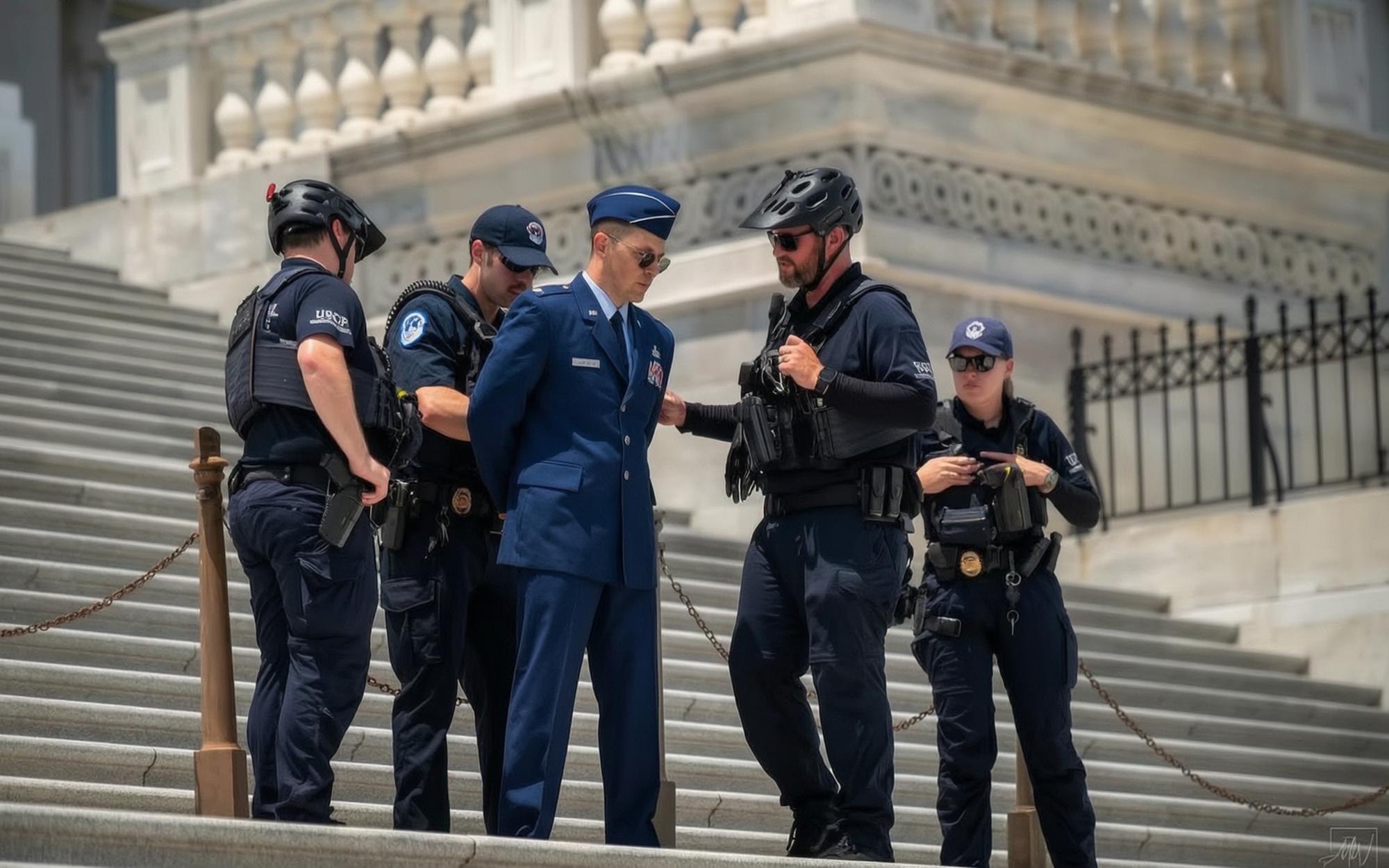
Under the UCMJ, active-duty service members are prohibited from participating in partisan activity—particularly in uniform.
The reasoning is simple: America’s fighting forces are sworn to defend the Constitution, not to play political games. When one airman stands in uniform to call for the removal of a sitting president, it undermines the trust and credibility the public places in its military institutions.
It’s also a slap in the face to every service member who keeps their political beliefs private to preserve the unity of the force. Maj. Watson didn’t just challenge regulations—he weaponized his position for attention, under the guidance of an activist group openly hostile to the Commander-in-Chief.
That kind of behavior damages morale, destroys cohesion, and threatens the apolitical foundation necessary for military professionalism.
What Denson and her protest network portrayed as an act of bravery amounts to a clear violation of the oath Watson swore when he donned that uniform. The military isn’t a stage for political theater, and officers are expected to understand that more than anyone. Instead, Watson used sacred symbols—the uniform, the oath, and the Capitol steps—to further a cause aligned with America’s radical left.
Meanwhile, the Air Force has so far made the correct moves: removing Watson from the public eye, securing him on base, and initiating a formal review of his misconduct. Acting Secretary of the Air Force Troy Meink reminded airmen that the War Department has zero tolerance for political posturing in uniform.
He emphasized that the investigation will proceed “unimpeded” and that commanders will “ensure appropriate disposition when holding service members accountable.”
That message was crystal clear—this isn’t about partisanship, it’s about preserving the sanctity and neutrality of the military institution. Still, the activist left and sympathetic media outlets will spin this as another case of “suppression,” conveniently ignoring decades of regulations that protect the military’s integrity.
The idea that Watson was somehow “upholding his oath” by attempting to publicly shame the Commander-in-Chief is ludicrous.
The oath he swore was to defend the Constitution against enemies foreign and domestic—not to take sides in partisan drama or to accuse his superiors of tyranny because he dislikes election outcomes.
Maj. Watson’s downfall serves as a hard reminder that service members don’t get to play activist when wearing the uniform of the United States.
The uniform represents every American, not one political belief. Getting arrested on the Capitol steps to chase political sympathy is not valor; it’s vanity.
If anything, this episode reinforces the importance of strong, clear leadership from officials like War Secretary Pete Hegseth, who continue to restore discipline and pride in America’s armed forces. The nation deserves a military focused on readiness and strength—not one distracted by partisan theater orchestrated by activists with axes to grind.