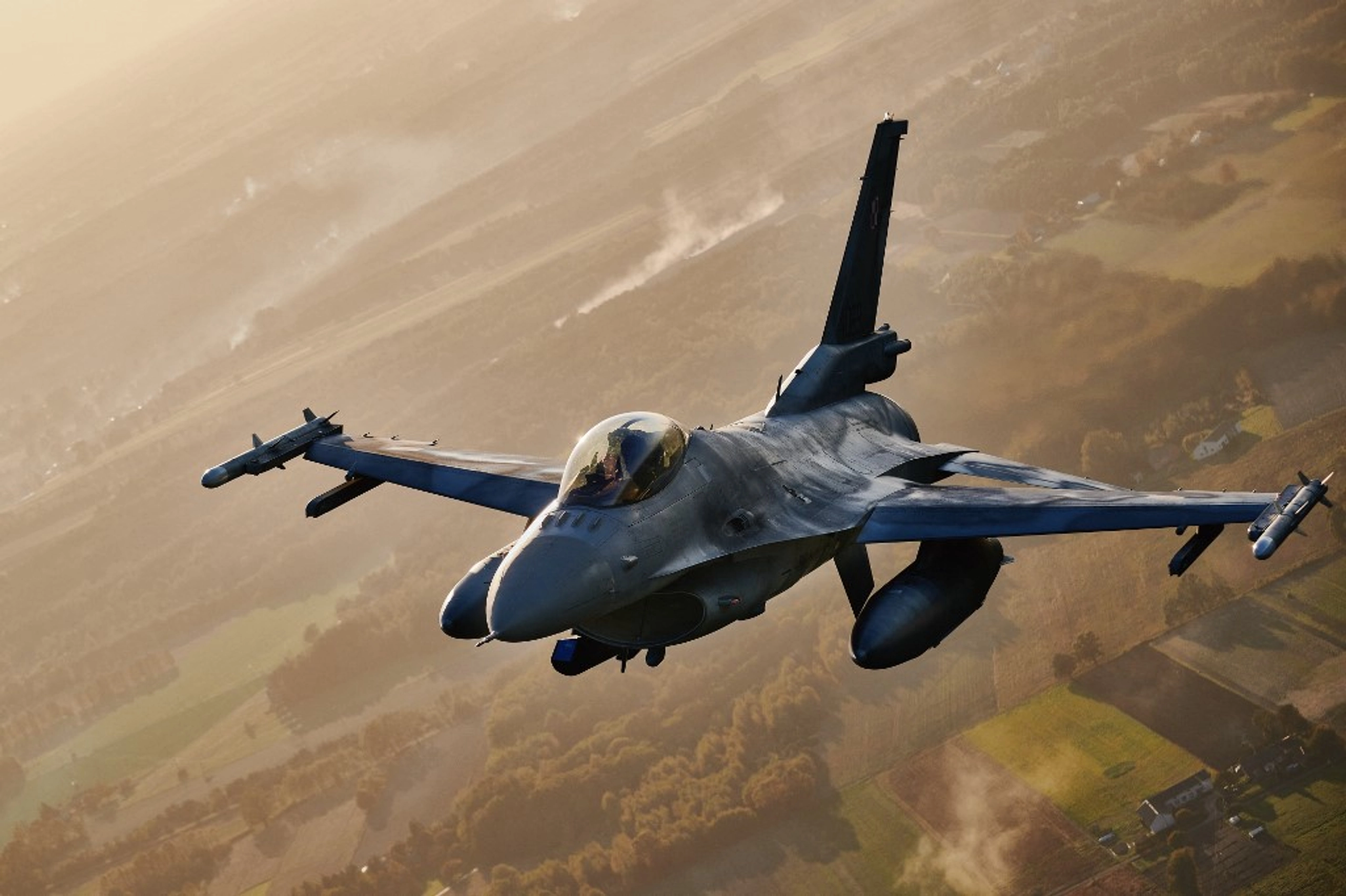
Ukraine’s small fleet of F-16 fighters has become one of the most important shields against Russia’s relentless drone attacks, but that success is coming at a serious cost.
The jets are killing drones by the thousands, while also burning through flying hours, maintenance life, and precious missiles that Kyiv cannot easily replace.
Airpower analyst Justin Bronk, writing for the Royal United Services Institute in Britain, said Ukrainian F 16s have destroyed more than 2,500 Geran and Gerbera one way attack drones.
That is an impressive tally, but it also shows the math problem Ukraine now faces because Russia is feeding the fight with industrial scale drone production.
“[The] use of fighters against such drones has consumed an unsustainable number of airframe flying hours and air-to-air missiles … since mid-2024, when the Ukrainian Air Force received its first Western aircraft and trained crews,” the analysis reads.
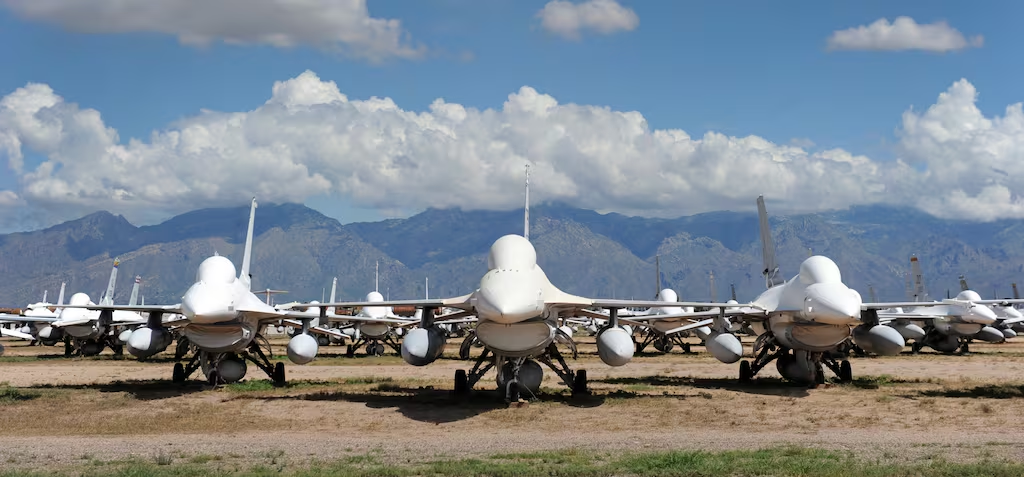
Bronk added, “Russian industry produces more than 6,000 [one-way attack] drones per month, and fighter aircraft have only a finite number of airframe hours available before they need time consuming deep maintenance cycles to be performed at a factory by expert technicians.”
That is the brutal reality of modern air warfare. A high end fighter can shoot down cheap drones all day, but if the enemy can build thousands more every month, the expensive aircraft eventually starts losing the endurance race.
Ukraine reportedly has about 39 F-16s in service out of roughly 79 pledged by Western European countries.
It also operates a small number of Mirage 2000 5 fighters promised by France, along with older Soviet era Su-27 and MiG-29 aircraft.
The F-16 has still changed the air war in important ways.
It allows Ukraine to launch stand off strikes with American JDAM bombs and French AASM Hammer glide bombs, and an F-16 reportedly shot down a Russian Su-35 over eastern Ukraine earlier this month.

But the same aircraft that gave Ukraine new reach is now being pulled into the drone grind.
“The F-16 fleet has been over-tasked, mostly by C-UAS [counter-drone] interception duties, for which there is almost unlimited demand over time,” Bronk said.
Ukraine is under pressure from several directions at once. Russia is not only launching drones, but also combining them with cruise missiles such as the Kh-101 and ballistic missiles such as the Iskander M and Kinzhal.
Kyiv has responded by building dense belts of short range air defenses along the front and around key cities. Those defenses include short range missiles, anti aircraft guns, machine gun teams, mobile crews, and locally built interceptor drones.
“What unites all these mobile air defense teams and counter-drone teams is that their equipment and ammunition is relatively cheap and thus their operations are sustainable,” the RUSI analysis noted.
“However, they are relatively personnel intensive to deploy at scale and require both force density and geographical depth to be effective.”
That creates another hard lesson for NATO planners, especially the ones who spent years pretending cheap threats could be handled by PowerPoint doctrine and procurement committees. Ukraine’s model works because it is dense, manpower heavy, and constantly adapted under fire.
“NATO cannot replicate the density of SHORAD defenses that Ukraine deploys for C-UAS coverage, due to the huge personnel requirements of doing so on a sustainable basis,” Bronk said.
The better answer may be layered protection for the most important sites, including airfields, command posts, and logistics hubs.
Radar guided guns and cheaper aircraft launched drone killers such as APKWS II rockets could help reduce the burden on manned fighters.
Still, short range air defense does not solve the cruise missile and ballistic missile problem.
Ukraine must husband high end interceptors such as Patriot and SAMP T missiles the way Israel and the United States must manage limited interceptor stocks during heavy missile exchanges.
That is why Bronk argues Ukraine should stop using F-16s as much as possible against disposable drones and reserve them for missions that require their speed, sensors, and weapons.
“Other systems need to be used wherever possible for [one-way attack] drones so that F-16 capacity can be used to intercept cruise missiles and deliver strike missions,” he said.

“Within the Ukrainian Air Force inventory, it is by far the most efficient asset for this.”
Bronk also believes Ukraine’s air force could produce stronger results if commanders closer to the fight had more freedom to plan missions.
“There is potential for the Ukrainian Air Force to have greater effects if squadrons and wings are given more authority to plan strikes themselves rather than being centrally tasked by Army-centric headquarters elements,” he said.
The lesson is plain enough for the Pentagon crowd and every NATO capital still waking up to the drone age.
Expensive aircraft remain indispensable, but using them as the first answer to every cheap drone swarm is a fast way to wear down the very force needed for the hardest missions.